Peeling and lifting is the most visible epoxy failure and the least specific. A film that curls at the edges and comes up in sheets can mean the coating never bonded (a preparation or material problem), or it can mean the slab is pushing it off from below (a moisture or a movement problem) — and those two get different fixes at different prices. Two checks separate them before anyone quotes you. Look at the back of a lifted piece: clean, dust-free concrete means the bond never developed, while concrete stuck to the film means the bond was fine and something lifted it. Then tap the floor with a coin and listen for hollow spots.
What peeling and lifting looks like
- Edge curl. The film lifts first at the perimeter, at the garage door apron, and along control joints — the places a walk-behind grinder cannot reach and a rushed job skips.
- Drummy spots. The coating still looks intact, but tapping it with a coin or a screwdriver handle gives a hollow sound. The film has already released; the visible tear comes later.
- Tire-shaped patches. In a working garage the failure usually starts in the two or four contact patches where the same car parks every night, because that is where the heat and the load are concentrated.
- Sheets, then plates. What starts as a curled edge becomes a plate of coating that lifts off in one piece, and the joints between plates fail next.
The pattern tells you something before anyone tests anything. A floor that lets go in the middle of a bay and never at the walls tends to be a moisture story. A floor that fails only at the perimeter and the door apron is usually a preparation story.
What causes it in a Denver garage
- Preparation that never reached profile. A resinous system needs a concrete surface profile of ICRI CSP 3 to 4 — a measurable roughness, not a visual impression. A film applied over laitance (the weak, chalky top layer that rises as a slab cures) is bonded to powder. That is the single most common cause of a floor that peels off in one large sheet, and it is also the failure most often blamed on the material.
- Moisture under the slab. Concrete has to read at or below 5 lbs per 1,000 sq ft per 24 hours on ASTM F1869 (calcium chloride) and at or below 75% RH on ASTM F2170 (in-situ probe) before a standard system goes down. Denver series soils are slow to drain: fine, smectitic clays formed from calcareous sedimentary rock, with saturated hydraulic conductivity low enough that water reaching a slab stays in the profile. Snow-melt and spring recharge keep feeding both. NWS normals for Denver International Airport run from a mean high of 44 F in January to 89 F in July. A rigid film only 2 to 5 mils thick has nothing in it to move with a slab that is doing that every year.
- A recoat over the wrong surface. New coating applied over an old sealer, a previous epoxy, or a painted floor without removing it bonds to that layer, not to the concrete — and it leaves with that layer.
How a pro confirms which one it is
Ask what is being done to reach a conclusion, not just what the conclusion is. The sequence that holds up is short:
- Tap test across the field and in the tire lanes, to map how far the film has already released.
- Peel-back sample at the failure edge, inspecting the back of the coating. Clean concrete on the film means the bond never developed. Concrete residue on the film means the bond worked and the slab lifted it.
- Moisture testing on the slab — ASTM F1869 for vapour emission and ASTM F2170 for internal relative humidity. Take the reading at the worst spot, not the convenient one; in a sloped garage the low corner beside a floor drain can read differently from the door, and the worst number governs the specification.
- Grind a test patch to see what actually comes up and what profile the slab can hold — this is how a pro confirms the surface was never prepared, or that it is sound.
- On a new slab, confirm the placement record: 28 days of cure minimum before any coating, and 2,500 psi minimum compressive strength. NWS normals for Denver International Airport run from a mean high of 44 F in January to 89 F in July. "It tested a bit high" cannot be checked. A reading in pounds and a reading in percent can.
What the fix involves, and what it costs
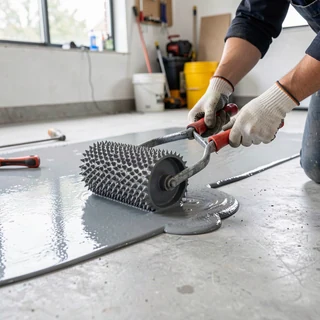
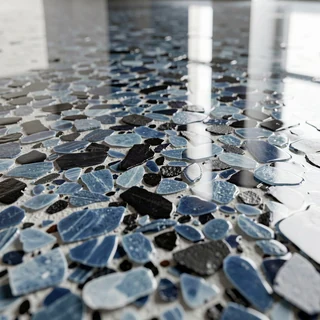
A floor that is lifting in sheets is not a patch candidate. The failed film is ground off to a CSP 3 to 4 profile — the same standard the original job should have hit — and if the moisture readings call for it, a dedicated moisture vapor barrier primer goes in below the base coat. Then the system is rebuilt: primer, high-build base, a double-broadcast flake or quartz layer, and a UV-stable topcoat.
Because the work is a removal plus a full system, the price lands in the same band as a new install.
Scope Ballpark Professional system, per square foot $4.00 to $15.00 Flake system, per square foot $4 to $9 Polyaspartic system, per square foot $6 to $9 2-car garage, whole job $1,800 to $5,500 Retail DIY kit $60 to $160 12-year outcome 12 to 15+ years of service on a professional build and $0 repair cost, against failure inside 24 months and $720 to $1,920 of repeat materials on the DIY route One more number that decides how a quote is written: a professional build finishes at 20 to 35 mils dry film thickness, while a retail kit lands at 2 to 5 mils. That difference is not cosmetic. It is the reason one floor can absorb a moving slab and the other cannot.
Frequently asked questions
Can peeling epoxy be patched, or does the whole floor come up?
A patch only holds where the surrounding bond is still sound. If the film is lifting in sheets, patching buys you a season and the rebuild still arrives. A floor failing across the field is a removal and rebuild: the film is ground back to a CSP 3 to 4 profile and a new system goes down, which is why the number lands in the same band as a new install.
How do I know whether it is moisture in the slab or just bad material?
Peel back a sample and look at the back of the film. Clean concrete means the bond never developed. Concrete stuck to the film means the bond worked and something pushed the coating off. Then have the slab tested: below 5 lbs per 1,000 sq ft per 24 hours on ASTM F1869 and at or below 75% RH on ASTM F2170 means the fix needs a moisture vapor barrier under the base coat.
What does fixing a peeling epoxy garage floor cost in Denver?
Plan on the professional band of $4.00 to $15.00 per square foot, or $1,800 to $5,500 for a 2-car garage. Flake systems run $4 to $9 per square foot and polyaspartic systems $6 to $9. Compare that against a $60 to $160 retail kit that fails inside 24 months and leaves $720 to $1,920 of repeat materials behind it over 12 years.
Related
Sources
- Denver series soils are slow to drain: fine, smectitic clays formed from calcareous sedimentary rock, with saturated hydraulic conductivity low enough that water reaching a slab stays in the profile.
- Denver series soils are slow to drain: fine, smectitic clays formed from calcareous sedimentary rock, with saturated hydraulic conductivity low enough that water reaching a slab stays in the profile.
- NWS normals for Denver International Airport run from a mean high of 44 F in January to 89 F in July.