Denver sits on ground that holds water in specific places. Denver series soils are slow to drain: fine, smectitic clays formed from calcareous sedimentary rock, with saturated hydraulic conductivity low enough that water reaching a slab stays in the profile. Snowmelt and ice-melt chemicals find those layers too. So a basement floor here is specified around moisture first: tested to ASTM F1869 and ASTM F2170, then covered with a system that includes a vapor barrier where the readings call for one. Published bands run $4 to $6 per square foot for a single-colour system with a clear coat, and $6 to $9 for full-broadcast flake with a polyaspartic topcoat.
What a basement floor job involves
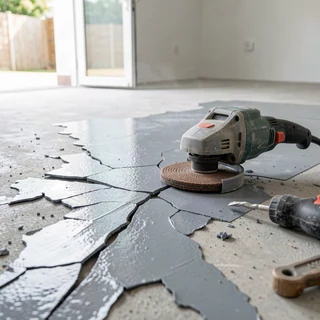
A basement is not a garage with a different address. The work starts with the slab: mechanical profiling to a CSP 3-4 anchor pattern, routing and flexible filling of moving cracks and control joints, and a penetrating primer to seal porosity. Then the film is built - a base coat carrying the first aggregate broadcast, a binder coat carrying the second, and a topcoat that becomes the walking surface.
Two details matter more downstairs than up. Cove base, where the floor turns up the wall, closes the joint that a mop and a spill both find. And ventilation or dehumidification during cure keeps vapor from condensing on a film that is still setting.
- Profile the slab mechanically, not with acid
- Route and fill moving joints with a flexible material such as EC-72 Epoxy Patch Gel
- Test moisture before choosing the system
- Specify a vapor barrier if either reading fails
- Build the aggregate broadcast to refusal, then scrape back the excess
Moisture is the design driver, not a detail
When vapor pushes up through a slab and meets a film that does not let it pass, the pressure has to go somewhere. It lifts the coating from below, and the result is edge blistering and bubbles that open, take in water and spread. That failure is a moisture failure - it happened before the first coat was mixed.
| Test | Standard | Pass threshold | If exceeded |
|---|---|---|---|
| Calcium chloride vapor emission | ASTM F1869 | Below 5 lbs per 1,000 sq ft | Specify a moisture vapor barrier |
| In-situ relative humidity | ASTM F2170 | Below 75% RH | Specify a moisture vapor barrier |
| New slab cure | Placement record | 28 days minimum hydration | Wait before coating |
A dedicated moisture vapor barrier such as EC-15 is engineered to hold back high vapor pressure and sit under the base coat. Ask for the numbers in writing - pounds for the F1869 test and percent relative humidity for the F2170 test - and for where on the slab each reading was taken. In a sloped basement the low corner often reads higher than the rest, and the worst number governs the specification.
Denver ground, snowmelt and what reaches a basement slab
The soils here are the reason basement floors get tested rather than assumed. Denver series soils are slow to drain: fine, smectitic clays formed from calcareous sedimentary rock, with saturated hydraulic conductivity low enough that water reaching a slab stays in the profile. Frost depth in this high-plains climate runs 36 inches, so the ground around a foundation goes through a real freeze-thaw cycle each winter, and snowmelt plus ice-melt chemicals work down through it.
Denver is also a dry climate indoors and out, with average July relative humidity near 30% and a mean January low near 25 F. That combination - a slab in contact with ground that holds seasonal water, inside a room that stays dry - is exactly why the test matters rather than the thermometer.
Water quality is genuinely local here too. Denver Water supplies 1.5 million people in Denver and its suburbs from mountain snowmelt, and it describes that water as moderately hard. Hard water leaves mineral film on a sealed floor and on mop water, so cleaning routine and residue differ street to street across the valley.
Systems, thickness and published cost bands
Basements are priced per square foot on the same bands as garages, and the system choice is driven by moisture and use rather than by size.
| Option | Published band | Best for |
|---|---|---|
| Decorative flake epoxy system | $4-9 per sq ft | Utility and rec-room floors; hides debris |
| Polyaspartic system | $6-9 per sq ft | UV-stable clear wear layer, fast return to service |
| All professional installs | $4.00 to $15.00 per sq ft | Depends on prep and vapor barrier required |
| Two-car garage, installed | $1,800 to $5,500 | Reference point for a floor of similar area |
Thickness separates a lifetime floor from a repaint. Professional double-broadcast builds finish at 20-35 mils dry film thickness and are expected to run 12-15+ years. A retail kit at $60-$160 produces 2-5 mils and generally fails inside 24 months. Across 12 years the DIY path costs $720 to $1,920 in materials plus the labour, against $0 in repair cost on a professional floor over the same period.
Finishes and slip resistance for a basement
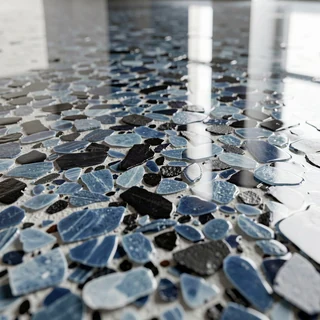
Decoration is the easy part once the slab is right. A decorative flake broadcast gives colour with visual texture and hides dust, lint and surface marks, which is why it is the default for utility zones. A solid pigmented system reads as one continuous field of colour with no joints. Metallic pigment produces fluid, three-dimensional depth that changes as light moves through the room.
Texture is a safety decision. Texturising aggregate broadcast into the topcoat - a fine graded quartz, or products such as CA-30 Small Safe Grip and CA-31 Large Safe Grip - becomes part of the film rather than a mat on top of it. That matters on a basement floor near a laundry sink, a water heater or a workshop bench, where a wet smooth surface is the hazard. Because the grit is integrated into the coating, routine sweeping and mopping do not wear the friction away.
Ask for the finish and the aggregate by name on the quote. A floor specified as heavy-duty in the base coat and left smooth on top is a slip risk dressed up as a specification.
Permits, timing and the questions to ask
A coating over an existing slab is a finish, but the work around it is not always. If the project involves framing, a new egress opening, electrical work or flattening a low spot with a pour, it can cross into permitted work. The permit follows the address: the City of Denver covers incorporated city limits, while parts of the valley with Denver or Aurora mailing addresses are in unincorporated Denver County and are permitted by the county. Denver Community Planning & Development permits the City and County of Denver under the Denver Residential Code 2025, and each suburb - Aurora, Lakewood, Arvada, Thornton, Westminster and Douglas County - runs its own building department, so the jurisdiction follows the address.
Frequently asked questions
Why do Denver basements need a vapor barrier when the climate is so dry?
Because the moisture comes from the ground, not the air. Denver series soils are slow to drain: fine, smectitic clays formed from calcareous sedimentary rock, with saturated hydraulic conductivity low enough that water reaching a slab stays in the profile. If a slab reads above 5 lbs per 1,000 sq ft on ASTM F1869 or above 75% RH on ASTM F2170, the system needs a barrier such as EC-15.
What does basement epoxy flooring cost?
Published bands are $4 to $6 per square foot for a single-colour system with a clear coat and $6 to $9 per square foot for full-broadcast flake with a polyaspartic topcoat, with professional installs generally $4.00 to $15.00 per square foot depending on preparation and whether a vapor barrier is required. A floor of a similar size to a two-car garage typically lands between $1,800 and $5,500 installed.
How long before I can use the basement again?
A fast-cure polyaspartic system allows foot traffic in as little as 24 hours. A slower build follows standard phasing: no pedestrian traffic for 0-48 hours, no vehicle or heavy equipment traffic before 72 hours, and full cure at five days.
Does a basement floor need a permit in Denver?
A coating over an existing slab is normally a finish. Denver Community Planning & Development permits the City and County of Denver under the Denver Residential Code 2025, and each suburb - Aurora, Lakewood, Arvada, Thornton, Westminster and Douglas County - runs its own building department, so the jurisdiction follows the address. Confirm the scope in writing before work starts.
Related
Sources
- Denver series soils are slow to drain: fine, smectitic clays formed from calcareous sedimentary rock, with saturated hydraulic conductivity low enough that water reaching a slab stays in the profile.
- Denver Water supplies 1.5 million people in Denver and its suburbs from mountain snowmelt, and it describes that water as moderately hard.
- ASTM F2170 - Standard Test Method for Determining Relative Humidity in Concrete Floor Slabs Using in situ Probes
- Denver Community Planning & Development - Residential Projects and building permits