Hot-tire pickup and white spotting look like dirt, and they are not. They are evidence that the wear layer of your floor softened under a tire that had been sitting on hot pavement — a coating problem, decided by the chemistry and thickness of the topcoat. That is a different failure from moisture vapour pushing up under the film and blistering it from below, which is a slab problem. The quick tell: black or brown marks that sit in the tire contact patches and wipe off with a solvent are transfer from the tire, while tall, hollow-sounding blisters are vapour. Denver's high-plains summer puts the coating side of that equation under real strain.
What it looks like, in the order it happens
- The marks. Four rectangles, or two if one bay stays empty, exactly where the tires sit. A dark smear is tire plasticiser transferring onto a film that has gone soft; a cloudy white haze is the same film losing its sheen.
- Tackiness. Under the tire footprint the surface feels different from the rest of the floor — often shinier in the middle of the patch, or dull at the edges where the tire has been rolling over it.
- The tear. As the tire cools it contracts, and cooling rubber grips a softened film. The result is a tire-shaped piece of coating pulled off the concrete, sometimes in the first summer, sometimes in the second.
- The repeat. The same tire parks in the same square foot of floor every night, so the failure repeats along the same track until the lane is a series of patches.
White spotting without any tire involvement has its own cause and is worth separating: dried hard water left to sit on a dulled film leaves mineral spotting, and road salt tracked in over a Denver winter does the same thing in the same places.
Why it happens here
NWS normals for Denver International Airport run from a mean high of 44 F in January to 89 F in July. A black-topped apron, a west-facing door pad and the slab just inside it sit well above air temperature through a July afternoon, and the tire carries that heat directly into the film.The same heat that softens a thin film also accelerates vapour movement through the slab, which is why a floor can show tire-shaped tears and dome-shaped blisters in the same summer. If your failure includes hollow, raised blisters, treat it as a moisture problem too.
How a pro confirms it is the coating and not the slab
Four questions and one test will pin it down.
- Ask for the dry film thickness the system finishes at. A 2 to 5 mil film and a 20 to 35 mil build behave in completely different ways under the same tire.
- Ask what the topcoat is, and what pavement temperature it is rated to withstand. A thermoset topcoat rated to 140 °F pavement is the answer you want for a garage with two daily drivers; "resistant to hot tires" on a kit label is marketing, not a number.
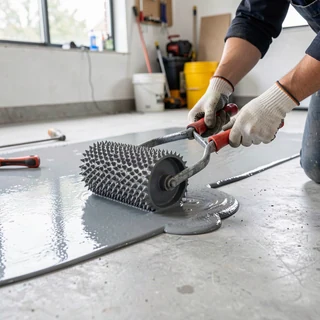
- Ask what surface profile the preparation achieves. ICRI CSP 3 to 4, verified, with the edges and corners brought to the same standard as the field.
- Tap-test the tire lanes. A hollow, drummy sound means the coating has already released from the slab even where the surface still looks intact. That is the point at which a small repair becomes a full re-coat if it is left another season.
- Test for moisture if there are blisters as well as marks: 5 lbs per 1,000 sq ft per 24 hours on ASTM F1869, or 75% RH on ASTM F2170, decides whether a moisture vapor barrier joins the specification.
One practical check you can do yourself: rub a white mark with a solvent-dampened rag. If it lifts, the mark is transfer sitting on the surface. If the mark stays and the sheen around it is gone, the film itself has been damaged — and that is the version that ends in a rebuild.
What the fix involves, and what it costs
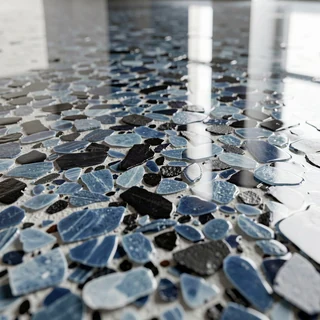
Cutting out tire-shaped patches only works while the surrounding film is a thermoset that will not soften again. If the whole floor is a thin thermoplastic film, new patches sit in the same condition as the old ones and the failure keeps moving down the lane. The permanent fix is mechanical: grind the floor to CSP 3 to 4, rebuild with a high-build base, a double-broadcast flake or quartz layer, and a thermoset polyaspartic topcoat. Polyaspartic returns to foot traffic in 24 hours.
| Scope | Ballpark |
|---|---|
| Polyaspartic system, per square foot | $6 to $9 |
| Flake system, per square foot | $4 to $9 |
| Professional system, per square foot | $4.00 to $15.00 |
| 2-car garage, whole job | $1,800 to $5,500 |
| Retail DIY kit | $60 to $160 |
| Expected life | 12 to 15+ years professional, against failure inside 24 months on the DIY route |
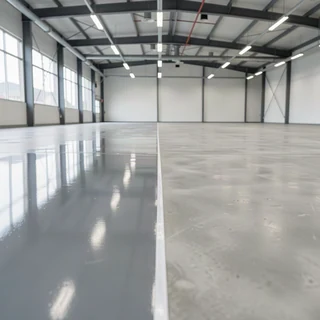
If the floor is part of a commercial space and the system has already failed, plan for traffic to be barred for 48 hours for pedestrians and 72 hours for vehicles while the rebuild cures. The $0 repair cost a professional floor carries over 12 years, against $720 to $1,920 of repeat materials on a DIY floor, is the part of this arithmetic most homeowners only see after the second failure.
Frequently asked questions
Why do my car's tires leave white marks on the garage floor?
The heat from the tire softens the top layer of the coating and lets tire plasticiser transfer onto the surface. On a thin thermoplastic film — a retail kit lands at 2 to 5 mils dry film thickness — the film also dulls and keeps the mark; on a thermoset polyaspartic topcoat over a 20 to 35 mil build, the tire has nothing to grip.
Can a hot-tire-resistant topcoat be added over the floor I already have?
Only if the existing film is sound, fully bonded and mechanically prepared, which is rarely the case once tire-shaped marks have appeared. In practice the floor is ground to a CSP 3 to 4 profile and rebuilt as a system, so budget in the same band as a new install: $4.00 to $15.00 per square foot, or $1,800 to $5,500 for a 2-car garage.
Does it really get hot enough in Denver to peel a garage floor?
Yes. NWS normals for Denver International Airport run from a mean high of 44 F in January to 89 F in July. Professional systems are rated for pavement temperatures up to 140 °F and for a service range down to −30 °F, which is the window this valley actually uses.
Related
Sources
- NWS normals for Denver International Airport run from a mean high of 44 F in January to 89 F in July.
- Denver series soils are slow to drain: fine, smectitic clays formed from calcareous sedimentary rock, with saturated hydraulic conductivity low enough that water reaching a slab stays in the profile.
- Denver series soils are slow to drain: fine, smectitic clays formed from calcareous sedimentary rock, with saturated hydraulic conductivity low enough that water reaching a slab stays in the profile.