Two failures get called cracking, and they need different money spent on them. A crack that is in the concrete and shows through the film is a slab problem: the concrete moved and the coating went with it. Delamination is a coating problem: the film loses its bond and releases in plates or chips, with clean concrete on the back of the film. A third pattern is both at once, where a crack opens and the film releases along its edge — that one is the slab telling you the coating was never flexible or thick enough for the movement it is living with. Denver's swing from about 45 °F January highs to about 90 °F July highs, plus hard freezes, is what drives the slab side of this.
The four crack patterns and what each one means
| What you see | What it usually is |
|---|---|
| Fine hairline cracks running across the field, visible as dark lines through the film | Shrinkage cracks in the concrete. Cosmetic unless they widen; the film is telegraphing what the slab did before it was coated |
| A straight, deliberate line that opens seasonally | A control joint. The joint was never honoured or filled with a material that can move — a rigid film bridges it and then splits |
| Cracks tracking the perimeter, the door opening or the base of a stem wall | Movement at the slab edge, and often preparation that never reached CSP 3 to 4 in exactly those places |
| Plates of coating with clean concrete on the back, and chips along the plate edges | Delamination — the bond never developed, or the slab drove the film off from below |
Why Denver slabs move, and why local soils matter
NWS normals for Denver International Airport run from a mean high of 44 F in January to 89 F in July. Concrete expands and contracts through that range every year, and a rigid film bonded to it has to move too. Thickness is what lets a system absorb it: 2 to 5 mils of a kit film has nothing to give, while a 20 to 35 mil professional build does.How a pro confirms which failure you have
- Peel test at the failure edge. Clean concrete on the back of the film means the bond never developed — preparation, contamination or an incompatible layer. Concrete stuck to the film means the bond held and the slab moved or drove it off.
- Tap test across the field to map the extent of release before anything is priced. A delaminated floor sounds different from a cracked but bonded one, and the difference can be thousands of square feet of scope.
- Map the cracks. Width, direction and whether they cross the joints or follow them. A crack that follows the perimeter is a preparation and edge-detail problem; a crack that crosses the middle of the bay is the slab moving.
- Moisture testing. ASTM F1869 at 5 lbs per 1,000 sq ft per 24 hours and ASTM F2170 at 75% RH. If either reads high, the rebuild gains a moisture vapor barrier — and that should appear as its own line in the quote.
- Grind a test patch to see the profile the concrete will hold and whether laitance is still sitting on the surface.
- On a new slab, confirm 28 days of cure from placement and 2,500 psi minimum compressive strength before any coating goes down. Both are pass-or-fail numbers, not preferences.
What the fix involves, and what it costs
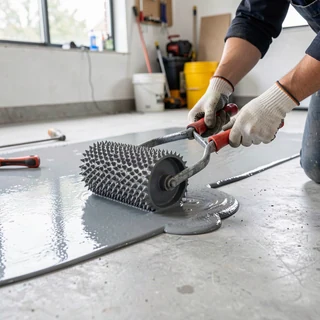
Cracks are routed, cleaned and filled with a material that can move with the slab, and joints are either honoured or filled to a specification that allows movement — patching a moving joint with a rigid resin simply transfers the crack to the next weakest point. Where the film has delaminated, the plate and the film around it come off, the concrete is ground to a CSP 3 to 4 profile, and the system is rebuilt, with a moisture vapor barrier below the base coat if the readings call for one.
Both scopes are priced per square foot of floor, which makes them directly comparable to a new install:
| Scope | Ballpark |
|---|---|
| Professional system, per square foot | $4.00 to $15.00 |
| Flake system, per square foot | $4 to $9 |
| Polyaspartic system, per square foot | $6 to $9 |
| 2-car garage, whole job | $1,800 to $5,500 |
| Service life after a correct rebuild | 12 to 15+ years before a topcoat rejuvenation, with $0 repair cost over that period |
One permit note, because slab work is where this changes: if a structural repair is part of the scope, confirm which jurisdiction is permitting it. A Denver or Aurora mailing address can sit inside the incorporated city or out in unincorporated Denver County. Denver Community Planning & Development permits the City and County of Denver under the Denver Residential Code 2025, and each suburb - Aurora, Lakewood, Arvada, Thornton, Westminster and Douglas County - runs its own building department, so the jurisdiction follows the address.
Frequently asked questions
Is a crack in my epoxy floor a coating problem or a slab problem?
Look at the film, not just the crack. If the coating is still bonded and simply showing a dark line where the concrete cracked, the slab moved and the coating behaved correctly. If plates of coating lift with clean concrete on the back, the bond failed — that is preparation, contamination or moisture, and it is the more expensive of the two.
Will a crack come back after the floor is recoated?
It can. A crack that has stopped moving can be routed, filled and coated over indefinitely. A crack that opens and closes seasonally — through a 45 °F to 90 °F swing with hard freezes and frost depths of 36 inches — will open again unless the fill material is designed to move with it, or the joint is honoured instead of bridged.
Does fixing cracks and delamination need a permit in Denver?
Coating a sound slab is normally not a permit item. Structural slab repair is a different scope: confirm whether the address is inside the incorporated city or in unincorporated Denver County before work starts, because each has its own permitting path. Denver Community Planning & Development permits the City and County of Denver under the Denver Residential Code 2025, and each suburb - Aurora, Lakewood, Arvada, Thornton, Westminster and Douglas County - runs its own building department, so the jurisdiction follows the address.
Related
Sources
- Denver series soils are slow to drain: fine, smectitic clays formed from calcareous sedimentary rock, with saturated hydraulic conductivity low enough that water reaching a slab stays in the profile.
- Denver series soils are slow to drain: fine, smectitic clays formed from calcareous sedimentary rock, with saturated hydraulic conductivity low enough that water reaching a slab stays in the profile.
- Denver Community Planning & Development permits the City and County of Denver under the Denver Residential Code 2025, and each suburb - Aurora, Lakewood, Arvada, Thornton, Westminster and Douglas County - runs its own building department, so the jurisdiction follows the address.