Denver is a high-plains city with July relative humidity near 30 percent, so a slab that looks bone dry is easy to accept at face value. Moisture in concrete does not come from the air above it. It comes from the ground below, and it moves upward through the slab whether the surface looks wet or not. This article answers the question that decides whether an epoxy floor stays bonded in the Front Range: what do the two standard moisture tests measure, what are the pass thresholds, and why does local ground change the reading?
A Dry Climate Is Not a Dry Slab
Surface dryness is a surface observation. A slab can look dry to the eye, feel dry to the touch and still be moving water vapour upward from below. Once a film is bonded over that surface the vapour has nowhere to go, so it collects under the coating and shows up as blistering in the first season and delamination after that.
That is why the specification for a standard system is written as two numbers rather than a look: below 5 lbs per 1,000 sq ft per 24 hours on ASTM F1869, or below 75% RH on ASTM F2170. Exceed either one and the system changes, not just the schedule.
The Two Tests and Their Pass Thresholds
The calcium chloride test measures how much moisture vapour is escaping the slab across a 24-hour window, reported in pounds per 1,000 square feet. It answers the question of how much water is leaving this concrete right now.
The in-situ probe test measures relative humidity inside the slab at depth and reports a percentage. In practice it is the stricter of the two, because it reaches moisture that a surface test can miss.
| Test | Standard | Pass threshold | If exceeded |
|---|---|---|---|
| Calcium chloride | ASTM F1869 | Under 5 lbs per 1,000 sq ft per 24 hours | Specify a moisture vapour barrier |
| In-situ relative humidity | ASTM F2170 | Under 75% RH | Specify a moisture vapour barrier |
Why Local Ground Changes the Reading
What sits under the slab decides how much water the slab sees. Denver series soils are slow to drain: fine, smectitic clays formed from calcareous sedimentary rock, with saturated hydraulic conductivity low enough that water reaching a slab stays in the profile. Testing is the only way to know which slab you have.
28 Days, 2,500 psi and the Permit Question
Moisture is not the only pass-or-fail number. Concrete needs 2,500 psi minimum compressive strength, and a new slab needs 28 days minimum of cure before any coating goes down. Below that the slab is still releasing water from within, and a film traps it.
If the project is more than a recoat, such as a new slab, a new drain or a structural repair, confirm the jurisdiction before work is priced. A Denver or Aurora mailing address can sit in unincorporated Denver County and be permitted by the county rather than the City of Denver, and the region shares one online permit portal. Denver Community Planning & Development permits the City and County of Denver under the Denver Residential Code 2025, and each suburb - Aurora, Lakewood, Arvada, Thornton, Westminster and Douglas County - runs its own building department, so the jurisdiction follows the address.
What Skipped Tests Look Like Two Years Later
Diagnostics are invisible on installation day and obvious afterwards. Vapour pressure that has been building under a film eventually wins: bubbles and blisters first, then curled edges, then sheets of coating peeling away from a slab that still looks sound underneath.
The failure usually gets blamed on material. It rarely is. A floor that comes up in sheets with clean concrete on the back of the film was bonded to a slab that was still driving moisture, or to a surface that was never profiled to hold a bond in the first place. The surface-profile guide covers the same failure from the preparation side.
How to Read the Numbers You Are Given
Ask for the F1869 reading in pounds per 1,000 square feet, the F2170 reading in percent relative humidity, and where each test was taken. In a garage with a floor drain or a slope, the low corner can read differently from the door, and the worst reading governs the specification.
Ask too when the reading was taken relative to the pour, because a test before 28 days of cure measures the schedule rather than the finished condition. As an independent matching service we do not test or install floors; we help homeowners ask for the numbers that make two quotes comparable.
Frequently asked questions
How long after pouring can a new slab be coated?
28 days minimum from placement, not from when the slab looks dry. Testing at that point gives the real reading, and if it is still above 5 lbs per 1,000 sq ft or 75% RH the schedule moves again.
Does an older slab still need moisture testing?
Yes. Older slabs often read high because of missing or failed under-slab vapour retarders, ground conditions, or drainage that changed over the years. Age does not predict moisture; only a test does.
Which test matters more, F1869 or F2170?
They measure different things: vapour escaping the surface and humidity inside the slab. The specification uses both, F1869 at 5 lbs per 1,000 sq ft per 24 hours and F2170 at 75% RH, and a failure on either one adds a moisture vapour barrier.
Do I need a permit to coat a garage floor in Denver?
A recoat usually does not trigger one. A new slab, a new drain or a structural repair can, and the jurisdiction has to be confirmed first, because part of the Denver and Aurora area is unincorporated Denver County.
How do I compare two quotes on this?
Ask each provider for the F1869 reading in pounds and the F2170 reading in percent relative humidity, with the test locations. A quote that includes a moisture vapour barrier and one that does not are different jobs, even when the totals look close.
Sources
- USDA-NRCS Official Soil Series Description: Denver series
- Denver Community Planning & Development (Community Development)
- Denver Community Planning & Development: residential projects
- Denver Community Planning & Development permits the City and County of Denver under the Denver Residential Code 2025, and each suburb - Aurora, Lakewood, Arvada, Thornton, Westminster and Douglas County - runs its own building department, so the jurisdiction follows the address.
Related
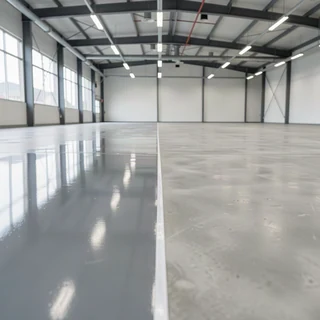
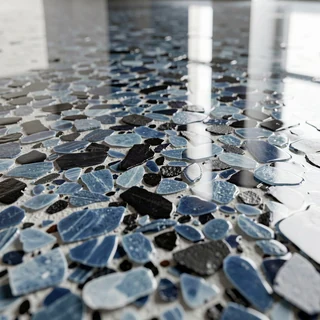
Epoxy Flooring services in Denver
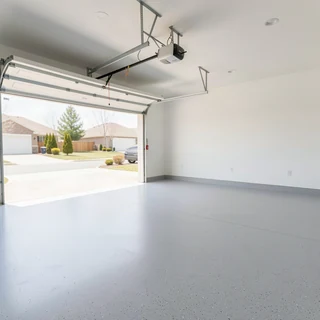
Garage Epoxy
A Denver garage slab works harder than any other floor in the house: summer surface heat, winter ice-melt brine, and a car that parks in the same two spots every night.
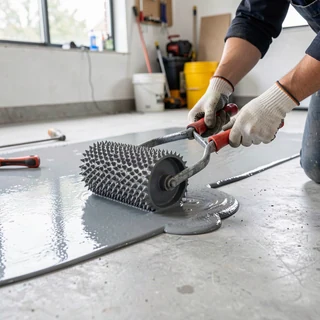
Basement Epoxy
A basement floor in Denver is a moisture question before it is a finish question, and the answer is decided by the slab, not by the coating.
Commercial Epoxy
A commercial floor is bought in hours of uptime, not in square feet of resin.
Metallic Epoxy
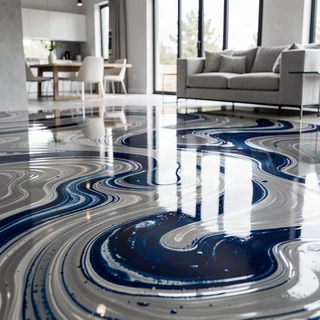
Metallic epoxy is a design floor built on an engineering system: the swirl is the topcoat's business, the bond is the slab's.
Polyaspartic Coatings
Polyaspartic is the coating that made the one-day floor possible, and it is the layer that decides how a Denver floor ages under a high-plains sun.
Concrete Coating Sealing
Raw concrete is a working surface, not a finished one, and sealing it is the cheapest way to stop dusting, staining and moisture at the surface.
Areas we serve
Denver
Epoxy Flooring in Denver, CO - costs, water and soil notes.
Aurora
Epoxy Flooring in Aurora, CO - costs, water and soil notes.
Lakewood
Epoxy Flooring in Lakewood, CO - costs, water and soil notes.
Arvada
Epoxy Flooring in Arvada, CO - costs, water and soil notes.
Thornton
Epoxy Flooring in Thornton, CO - costs, water and soil notes.
Westminster
Epoxy Flooring in Westminster, CO - costs, water and soil notes.
Highlands Ranch
Epoxy Flooring in Highlands Ranch, CO - costs, water and soil notes.